This Week's Focus: High-Rise Installation + Floor Marking and Labeling – Making Robotic Warehouses Stable from Zero to Height.

概括

From a single pillar to a shelf, from a red line to a QR code , everything we do is aimed at enabling robots to "find their way and make accurate judgments.

您将阅读以下内容:

介绍

The creation of an automated warehouse often begins in the “unseen places”.

When you see unmanned forklifts moving smoothly and bin robots picking up goods accurately, you may not know that before this, our team had already completed two of the most basic and crucial tasks : high rack installation  和  ground marking and labeling .

High-rack installation – Building the "skeleton" for the robot

Shelves are the skeleton of a warehouse. If the skeleton is not aligned, the robots will not be able to move accurately.

Hotmeer provides:

✅  Automated warehouse racking construction (compatible with bin robots)

✅Installation  of shelving systems by major robot manufacturers   such as Hai Robotics, Hikrobot, Geek+, and Quicktron.

✅Automated  forklift & four-way shuttle system racking solutions

The verticality of every upright column, the horizontality of every beam, and the aisle width between every two rows of shelves—we strictly adhere to the robot navigation requirements. Even a deviation of just 1 centimeter could cause the robot to collide with or drop goods when retrieving items at high speed.

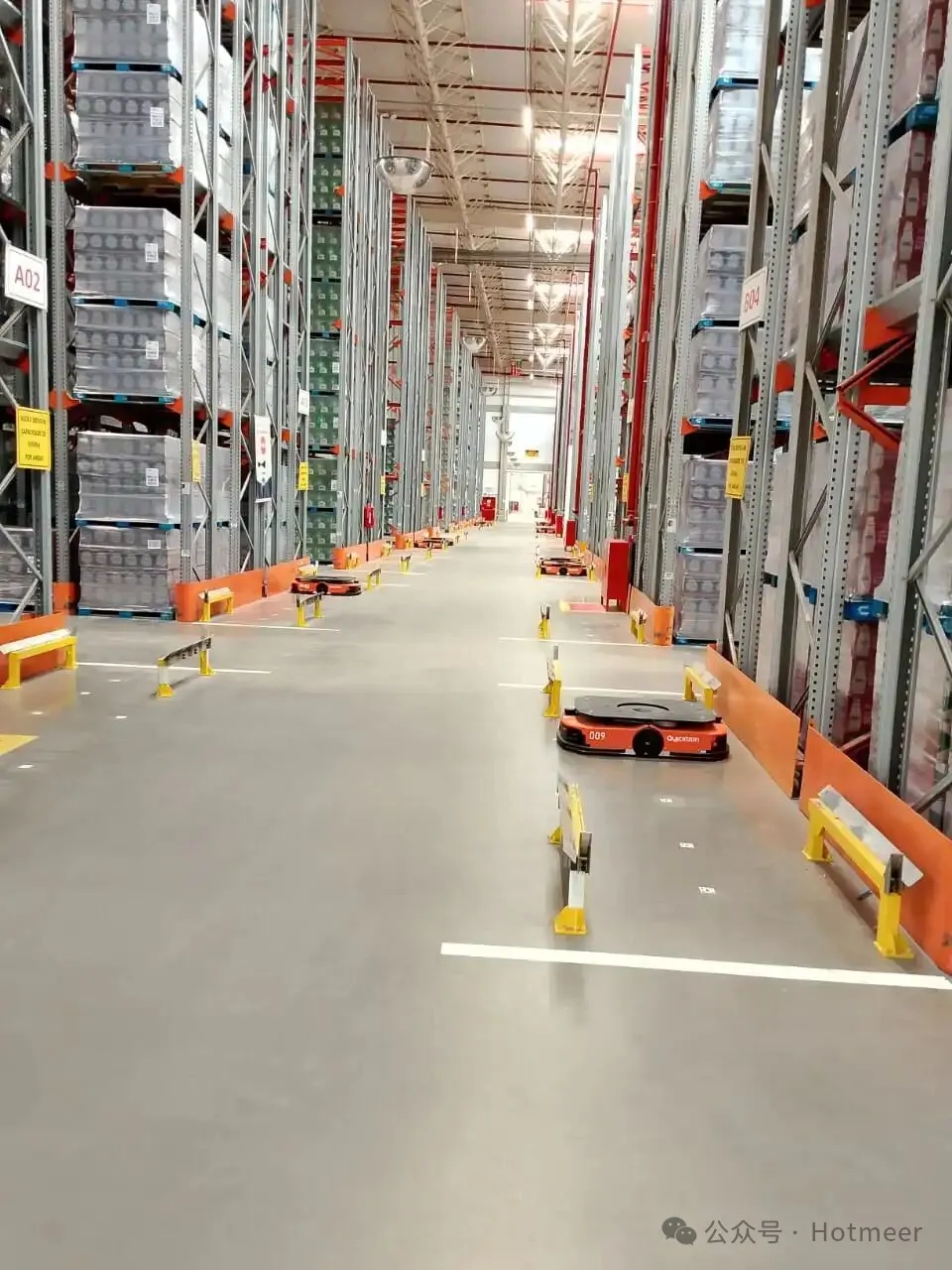
Marking & Labeling – “Drawing Tracks and Labeling Markers” for the Robot

Robots don’t use their eyes to see where they’re going; they rely on ground markings 和 QR codes .

Hotmeer provides:

✅Based  on on-site requirements, perform ground marking and QR code affixing for robot navigation:   • Red/yellow/blue zone lines   • Safety passage lines   • Robot travel path lines   • High-precision QR code placement (each code’s coordinates correspond one-to-one with the system).

✅  Marking and positioning services for racking installation & conveyor system installation

Ground marking isn’t just about randomly sticking on tape—we use laser rangefinders to calibrate the straightness of each line to ensure the robot’s LiDAR can reliably recognize it. The precision of QR code placement is even more precise, down to the millimeter level , because the robot calibrates its position by scanning the QR codes; a one-millimeter misalignment could result in a one-meter deviation.

Why are these "basic skills" worth discussing separately?

The actual situation inside the warehouse is:

  • Uneven shelving → causing the robot to wobble and drop goods when retrieving them.

  • The ground lines were drawn crookedly → the robot navigation system had to frequently correct its course, resulting in decreased efficiency.

  • The QR code was misaligned → Robot positioning failed, error message displayed.

Hotmeer’s team came to fill these “gaps”.

We provide not only the equipment, but also the “foundation” that enables the equipment to operate properly . From the shelves to the ground, from marking lines to labeling, our engineers are on-site to verify every step using levels, laser rulers, and debugging terminals.

结论

Behind every smoothly operating automated warehouse, there is a group of people working hard in the “unseen places”.

We are  your 24/7 automation assistant — from the erection of the first shelf column to the final QR code being affixed to the ground, and the robot successfully completing its first task, we are always on-site.

You can focus on operating the business with peace of mind, and leave the rest to us.

最新帖子

查看我们的特色产品

仓库中的移动机器人,包括箱体处理机器人、货架移动机器人、叉车 AGV 和分拣机器人。

想要了解更多?
联系我们

常问问题

Why is high-rack installation critical in automated warehouses?

High-rack installation forms the structural foundation (“skeleton”) of the warehouse. If alignment, spacing, or load tolerance is inaccurate, robots may misnavigate, collide, or fail to retrieve goods efficiently. Precision here directly impacts system stability and throughput.

What are the risks of poor marking and labeling?

Incorrect or low-precision markings can cause navigation errors, inefficient routing, and even system failures. Misaligned QR codes, for example, can result in incorrect positioning or task execution errors, reducing overall operational efficiency.

How do ground markings and QR codes help warehouse robots?

Robots rely on visual navigation systems. Ground markings guide movement paths, while QR codes provide exact positional data. Together, they ensure accurate routing, stopping points, and task execution with minimal error.

How precise does QR code placement need to be?

QR codes require extremely high precision—often within millimeter-level accuracy. Even slight deviations can lead to navigation drift, causing robots to misinterpret their location and perform tasks incorrectly.

Why are these “basic” installation steps often underestimated?

Because they are not visually complex, but they are technically critical. Issues like uneven shelving or inaccurate markings create downstream inefficiencies that are costly to fix later. Proper execution at the foundation level ensures long-term system reliability.